I
had a plan for my next post. I was going
to review Craig Boddington's “Buffalo!” book, or talk about the reasons I
dropped hundreds of dollars on custom-fitted Russell safari boots, or describe
the safari rifle match that the Phoenix Rod & Gun Club puts on twice a
year. Then one of the members of Pistol-Forum.com linked to my blog there today.
They’re a good bunch of people over there, and the signal-to-noise ratio
tends to be far better than on a lot of internet forums, so of course some
discussion happened. And the subject
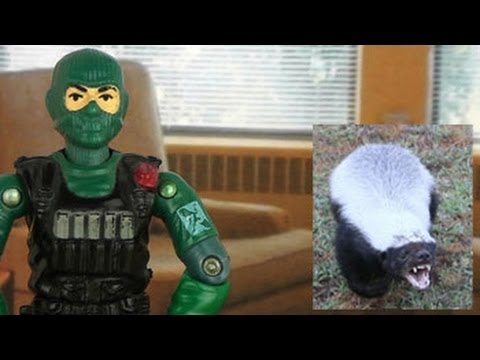
quickly turned to taxidermy, honey badgers, and the character of Stanley from
Action Figure Therapy (very NSFW, but I find them utterly hilarious).
In
all seriousness, though, I'm somewhat torn on the subject of taxidermy. To me,
ethical hunting comes in one of three forms: meat, dangerous game, and pest
control. I'll eat the antelope I'll shoot in Africa, and going up against a
lion or elephant or buffalo on its home turf at least gives the critter a
fighting chance. The badger is none of these, nor do I think he falls under
pest control (although I know at least two hunters who found honey badgers
raiding the skinning shed and making off with their trophies). There's also my
belief that, as a living creature, it deserves a certain level of respect. I
would have no issue displaying a completely fake statue of Stanley the Honey
Badger, with cigarette, AKM and upraised middle finger, but I think there's
something inherently disrespectful about taking a living badger, shooting it,
and making it into a joke display piece. Ergo, while I may crack a joke or two
about having a real Stanley, I can't see myself actually going through with it.
I've never been a big taxidermy fan in general. I've never mounted any of my whitetails. I have eaten them all and used their antlers for projects, or given them to friends who use them to make knife hilts and coat buttons, and I see that as keeping parts of the animal from going to waste. That said, I can see the value in taxidermy as a reminder of a significant and meaningful event. To see the animal, especially rendered in a realistic pose, is to flash back to the warm memory of the hunt itself, and perhaps recapture some little flash of the adrenaline and majesty. In that sense, when the taxidermy is a tribute to the animal and the chase, rather than a trophy hanging on the wall to brag about one's own prowess, I can honestly appreciate it. I certainly don't begrudge people who have their prey immortalized in such a manner.
I've never been a big taxidermy fan in general. I've never mounted any of my whitetails. I have eaten them all and used their antlers for projects, or given them to friends who use them to make knife hilts and coat buttons, and I see that as keeping parts of the animal from going to waste. That said, I can see the value in taxidermy as a reminder of a significant and meaningful event. To see the animal, especially rendered in a realistic pose, is to flash back to the warm memory of the hunt itself, and perhaps recapture some little flash of the adrenaline and majesty. In that sense, when the taxidermy is a tribute to the animal and the chase, rather than a trophy hanging on the wall to brag about one's own prowess, I can honestly appreciate it. I certainly don't begrudge people who have their prey immortalized in such a manner.
I do plan to have what I shoot on my safari properly taxidermied. I’d love to have a zebra rug, for
instance. Unless I
shoot something that belongs in the SCI record book or takes an inordinate
amount of effort and luck to shoot, I will likely do European skull mounts for
most of what I take. I’d rather spend my
limited budget on trophy fees than taxidermy. I also want to have most of
the hides tanned for making into gloves, boots, jackets, and if I find something
suitably thick-skinned, perhaps a holster, knife sheath, mag pouch, rifle sling,
etc. It’s all part of making the most
out of what I take as a hunter.
In
the end, I suppose I agree with Jose Ortega Y Gasset, as he stated in his “Meditations
on Hunting”:
“One does not hunt in order to kill; on the contrary, one kills in order to have hunted. If one were to present the sportsman with the death of the animal as a gift he would refuse it. What he is after is having to win it, to conquer the surly brute through his own effort and skill with all the extras that this carries with it: the immersion in the countryside, the healthfulness of the exercise, the distraction from his job.”
“One does not hunt in order to kill; on the contrary, one kills in order to have hunted. If one were to present the sportsman with the death of the animal as a gift he would refuse it. What he is after is having to win it, to conquer the surly brute through his own effort and skill with all the extras that this carries with it: the immersion in the countryside, the healthfulness of the exercise, the distraction from his job.”
I'd love to hear some feedback on the subject of taxidermy, and what it means to other hunters.
